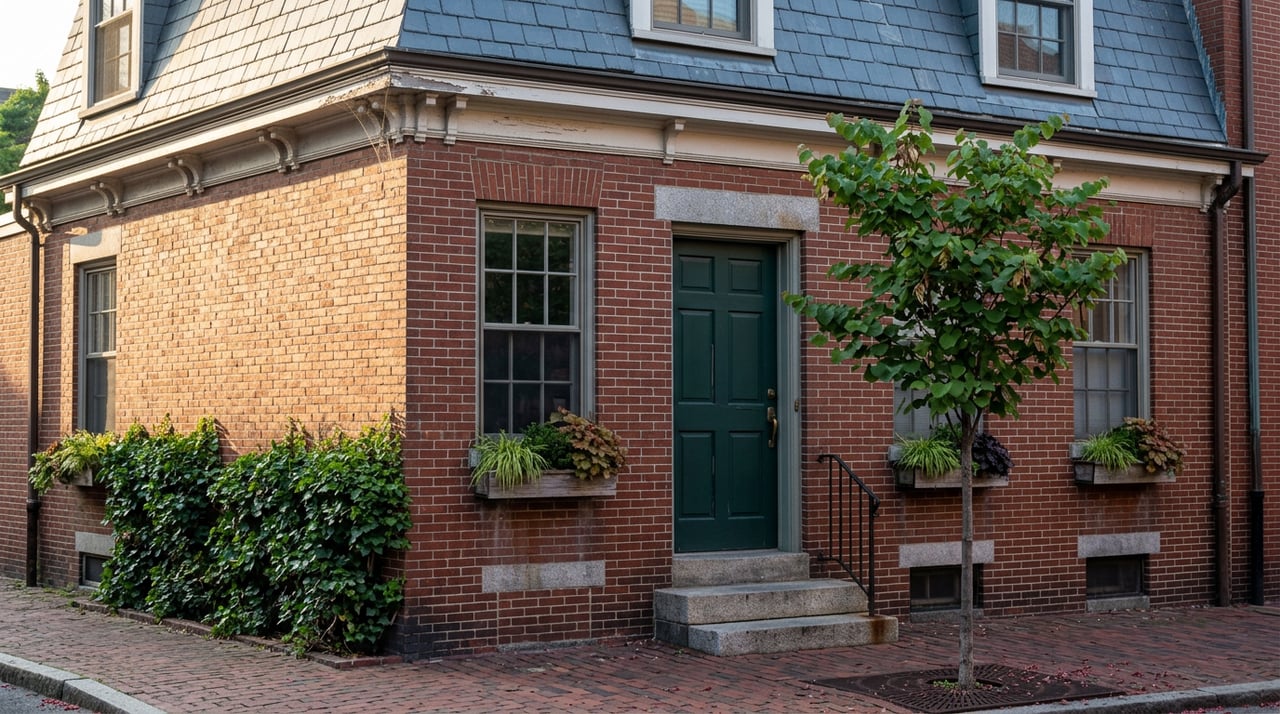
In April, James and Mary Weisheit paid $2.49 million for a shingled 1850s building in Kittery Foreside called the Cook Block. It has three commercial units and eight apartments, and within weeks of closing the new owners had a pizza shop signed and leased. "I love the building. I think it's a cornerstone of the Foreside," James Weisheit told Mainebiz. Three months later, a boutique hotel called the Foreside Inn opened a few blocks away on Wentworth Street, 24 rooms across two buildings, walking distance to downtown Portsmouth.
None of that reads like a discount market. And that is the point.
For years, the pitch to buyers standing at the Memorial Bridge has been simple: Portsmouth for the walkable brick downtown and the tax-free paycheck, Kittery for the same river view at a lower price. The price gap is real. But the mechanics behind it just shifted in three separate ways this year, and none of them show up in a median-price headline.
The Number Everyone Already Has
Over the three months ending May 2026, homes in Kittery sold for a median of $718,000, up 4.2 percent from the same period a year earlier, with price per square foot running $404. Across the river, Portsmouth's median sits around $785,000 as of an April 2026 update, up 5.1 percent year over year. Late last year, Portsmouth's price per square foot was running closer to $561, roughly 39 percent above where Kittery was pricing this spring.
That comparison is the one every relocation guide runs. Here is what it leaves out: Kittery's own median has been swinging wildly depending on which month you check. One report put the town's June 2026 median at just over $1.09 million. A three-month rolling window put it at $718,000. That is not a typo or a bad data source. It is what happens in a small, luxury-tilted market where a single Foreside or waterfront closing can drag the median toward seven figures in a slow month. Kittery is not one market. It is a working-waterfront town and a seven-figure enclave sharing a zip code, and the seven-figure side is the one where the next two mechanisms actually bite.
| Kittery, ME | Portsmouth, NH | |
|---|---|---|
| Median sale price | $718,000 (three months ending May 2026) | $785,000 (year to date through April 2026) |
| Price per square foot | $404 (May 2026) | $561 (late 2025) |
| Typical days on market | 18 days, down from 43 a year earlier | 18 days |
A Rate Cut That Isn't What It Looks Like
In September 2025, Kittery's Town Council set a new property tax rate of $9.29 per $1,000 of assessed value, a drop of almost 35 percent from the prior rate of $14.20. On its face, that reads like Kittery just got cheaper to own in. It didn't, not exactly.
The rate dropped because the town completed a full property revaluation effective April 1, 2025, and Kittery's total taxable value jumped by roughly $1.3 billion. A lower rate applied to a much higher base is not the same as lower taxes. It is the same taxes, redistributed onto values that finally match what homes are actually selling for.
Here is why that matters more in Kittery than in most neighboring towns right now. When a town hasn't revalued in years, its assessments lag market value, and the mill rate has to run artificially high to raise the same revenue. Two towns can have identical real tax burdens while one shows a rate of $12 and the other shows $24, purely because one revalues more often. Kittery just reset its assessments to full market value, which means its new $9.29 rate is one of the few in York County you can compare at face value against a neighboring town's headline number. Most others still need an equalized full-value adjustment to mean the same thing.
For a buyer, the practical read is this: Kittery's tax rate is genuinely low right now, but it is low because assessed values just caught up to the market, not because the town's cost of running itself dropped. The next revaluation cycle, whenever it comes, resets the arithmetic again.
The Threshold That Moved While Nobody Was Looking
Maine's real estate transfer tax has run at a flat $2.20 per $500 of sale price for years, split evenly between buyer and seller. That didn't change. What changed, effective for any deed recorded on or after November 1, 2025, is what happens above $1 million. Maine now adds an extra $3.80 per $500 on the portion of a sale price that exceeds that threshold, a combined $6.00 per $500 on the amount above $1 million.
A median Kittery buyer at $718,000 barely notices this. Total transfer tax on that sale runs about $3,159, split into roughly $1,580 on each side of the closing table.
A buyer at $1.2 million feels it differently. Under the new tiered structure, the first $1 million is taxed at the standard rate for $4,400, and the remaining $200,000 is taxed at the combined $6.00 rate for $2,400, a total of $6,800. Under the flat rate that applied before November 1, 2025, that same $1.2 million sale would have owed $5,280. The difference, $1,520 total or $760 per side, lands squarely on the waterfront and Foreside properties that Kittery's own volatile median suggests are becoming more common, not less.
That threshold was set with high-value coastal transactions in mind. Kittery's price data shows it is already crossing that line often enough for the new tier to matter.
What This Actually Means If You're Comparing the Two Towns
- Run the total cost, not the sticker price. New Hampshire has no state income tax and no general sales tax, which changes the math for anyone planning to earn a paycheck there. Maine layers its transfer tax and, for sellers, a 7.15 percent state tax on any capital gain beyond the standard federal exclusion of $250,000 single or $500,000 married. A lower Kittery purchase price doesn't automatically mean a lower total cost of ownership over time.
- Ask when a town last revalued. Kittery's $9.29 rate is current and comparable. A neighboring town quoting a lower headline rate may simply be overdue for its own revaluation, which means the number you're comparing against isn't apples to apples yet.
- Price the transfer tax tier into any offer near or above $1 million. The $6,800 total on a $1.2 million Kittery purchase is a real closing cost that didn't exist in this form a year ago, and it's worth factoring into negotiation on who pays what share.
- Treat Kittery's median with a grain of salt month to month. A market this size moves on a handful of closings. A single waterfront sale can shift the headline number more than any underlying trend does.
The Foreside Is Already Pricing This In
The clearest evidence that Kittery's discount is narrowing isn't in the tax code. It's in who is buying commercial property there. A $2.49 million sale on a mixed-use building in Kittery Foreside, a new 24-room boutique hotel steps from the bridge, and the mixed-use studio and housing project the design firm Winter Holben completed on Walker Street are not the moves of investors treating Kittery as Portsmouth's discount cousin. They're the moves of people underwriting Kittery Foreside at valuations that assume the gap keeps closing.
That doesn't mean Kittery and Portsmouth converge overnight, or that a buyer chasing river views should ignore the current price difference. It means the calculation that made Kittery the obvious value play a few years ago now needs updating for a revaluation that reset the town's own tax arithmetic, a mansion-tax tier that starts exactly where the town's high end trades, and a wave of capital that has already stopped treating the Foreside as a bargain.
A Few Questions Worth Asking Before You Compare Towns
Does Maine's transfer tax apply if I'm selling one Maine home to buy another? Yes. The tax attaches to the deed on the property being sold, not to what you do with the proceeds. Only specific transfers, mainly between immediate family members, are exempt under Maine law.
Will Kittery's lower tax rate hold if my home's assessed value keeps climbing? Not necessarily. The rate is set each year to match the town's budget against total assessed value. If Kittery's overall taxable value keeps rising faster than its spending needs, the rate could drop further. If spending grows faster than assessed value, the rate rises again, even without another full revaluation.
Is an $1.2 million purchase actually typical in Kittery right now? Not for the median buyer, but not rare either. The town's own median has bounced between roughly $718,000 and just over $1 million depending on the three-month window, which tells you the high end of the market is active enough to move the average on its own.
If you're weighing a purchase near this line, on either side of the Piscataqua, the numbers rarely tell the whole story on their own. Williams & Co. works both the Maine and New Hampshire sides of this exact comparison every week, and can walk you through what a specific address would actually cost to close on and to own. Let's Connect.